
10
A well-chosen dress should feel like a natural extension of your personal style, effortlessly highlighting your favorite features while creating balance across your entire frame. For women with athletic silhouettes, swimmer builds, or inverted-triangle body types, broad shoulders offer striking posture and a statuesque presence. At the same time, finding a dress that feels proportionate rather than top-heavy can quickly turn into a frustrating shopping experience.
When a garment is cut without your proportions in mind, it can make the upper body feel boxy or uncomfortably rigid. The secret to dressing broad shoulders is never about hiding your frame or shrinking into oversized layers. Instead, it comes down to intentional optical balancing. By breaking up the horizontal line across your upper chest, softening the transition from neck to arm, and building visual interest through the skirt, you can transform your shoulders into a balanced anchor for any silhouette.
The Visual Geometry of Broad Shoulders
To understand how to dress broad shoulders, it helps to understand how the human eye registers shape and proportion. When someone looks at an outfit, their gaze naturally tracks along strong, uninterrupted lines. If a dress features a straight, horizontal neckline or rigid, outward-pointing shoulder seams, the viewer’s eyes travel directly across the widest point of your upper body, emphasizing its horizontal width.
Softening that effect requires introducing vertical and diagonal lines. When you introduce verticality, you guide the eye inward and downward, dissecting the width of the chest into narrower, more balanced segments. Simultaneously, adding structure, volume, or movement around the hips balances the visual weight of your top half. Dressing broad shoulders is essentially an exercise in counterweight: whatever breadth exists up top simply needs an opposing design detail below to create harmony.
Necklines That Create Inward Focus
The neckline of a dress is the most powerful tool you have for altering how shoulder width is perceived. Because it sits directly between the clavicles, the shape of the collar instantly dictates where the eyes land.
The Elongating Power of V-Necks and Deep Scoops
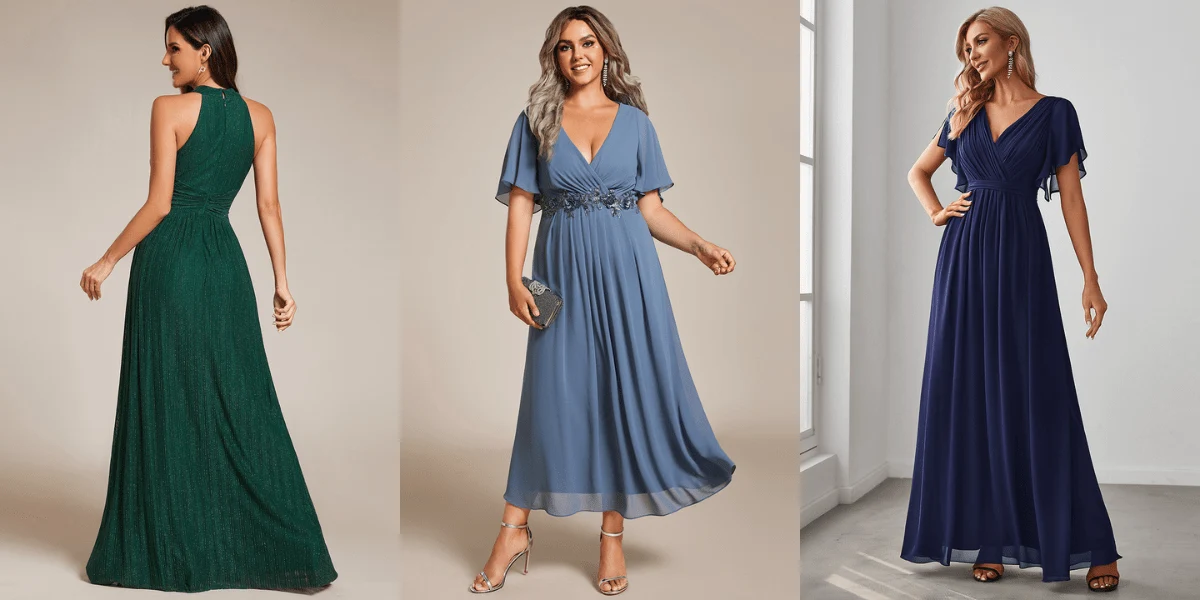
A classic V-neck is arguably the most effective neckline for broad shoulders. The sharp diagonal lines of a V draw the eye down toward the center of the torso, slicing the horizontal span of the chest in half. A moderate to deep V-neck creates an illusion of vertical length, making the neck look longer and the upper body look leaner.
Deep scoop necks achieve a similar effect with softer edges. By exposing the center of the décolletage in a gentle, rounded curve, a scoop neck eliminates harsh horizontal borders and softens angular bone structure. For formal occasions, a notched neckline or a plunging sweetheart cut provides that same inward draw while maintaining an elevated, structured feel.
Asymmetrical and One-Shoulder Cuts
Asymmetry is a remarkably flattering, often underutilized technique for broad frames. A one-shoulder dress cuts diagonally across the torso from the base of the neck to under the opposite armhole. This diagonal sweep completely disrupts the horizontal baseline of the shoulders. Rather than seeing two shoulders sitting on a level plane, the eye is forced to follow a dynamic diagonal angle, which immediately downplays width.
Necklines to Treat with Caution
Not all necklines serve a wider frame well. Horizontal openings, such as classic boat necks (bateau), wide off-the-shoulder cuts, and sharp square necklines, draw a straight line directly from shoulder point to shoulder point. These styles act almost like a visual ruler across the upper chest, maximizing the appearance of breadth. Similarly, high, restrictive crew necks create a solid canvas of fabric that can make the chest and shoulders look broader and more imposing than they actually are.
Sleeve Architecture and Shoulder Seams
Where and how a sleeve attaches to the bodice can completely redefine the silhouette of your upper body. A common mistake is assuming that covering the arms automatically slims the shoulders, but the wrong sleeve construction can actually add bulk right where you least want it.
Raglan and Seamless Sleeves
Traditional set-in sleeves have a seam that sits right on the outer corner of the shoulder bone. If the shoulder seam fits even slightly too narrow, it pulls tightly across the back; if it drops too low, it widens the frame. Raglan sleeves bypass this issue entirely. By running a diagonal seam from the collarbone down under the armpit, raglan cuts remove the visual corner of the shoulder, creating a soft, sloping line that rounds off square edges.
Dolman, batwing, and kimono sleeves operate on a similar principle. Because they lack a defined, tailored shoulder point, the fabric cascades smoothly over the arm without delineating where the shoulder ends and the arm begins. This fluidity blurs sharp contours and creates an effortless, relaxed drape.
Strap Widths for Sleeveless Styles
If you prefer sleeveless dresses, pay close attention to the width and placement of the straps. Ultra-thin spaghetti straps create a stark optical contrast: against a broad expanse of shoulder, tiny string straps make the surrounding area look noticeably wider by comparison.
Instead, look for dresses with wide shoulder straps measuring at least two to three inches. Straps that sit closer to the neck rather than pushed out toward the shoulder edge cover a portion of the horizontal span, visually dividing the chest into smaller thirds. Halter dresses can also work beautifully, provided the halter angles inward toward the neck rather than pulling outward toward the armpits.
Sleeves to Avoid
Any design feature that adds volume, height, or structure directly on top of the shoulder will amplify breadth. Pass on puff sleeves, heavily gathered cap sleeves, pleated shoulder caps, and structured shoulder pads. Cap sleeves are particularly tricky because they usually end right at the widest point of the upper arm, creating an uninterrupted horizontal shelf that widens the upper body.
Balancing Proportions with Skirt Architecture
Softening broad shoulders is only half about the bodice; the other half happens from the waist down. When your lower half is narrow and your upper half is broad, straight or clinging dresses can give you an inverted triangular shape. Adding volume, texture, or movement to the skirt provides the necessary counterweight to make your shoulders look intentionally statuesque rather than disproportionate.
A-Line and Fit-and-Flare Silhouettes
The A-line dress remains the gold standard for balancing wide shoulders. Fitted through the torso and gently flaring outward toward the hem, an A-line silhouette mirrors the width of your shoulders, creating the visual symmetry of a balanced hourglass. Fit-and-flare dresses take this a step further with a crisply defined waist that blooms into a fuller skirt, instantly drawing attention downward and balancing the upper body.
Pleats, Tiered Ruffles, and Bias Cuts
Do not shy away from visual details on your lower half. While ruffles or bold details on the shoulders may work against you, those exact same features look exceptional on a skirt. Multi-tiered skirts, sunburst pleats, cascading ruffles, and handkerchief hems add texture, kinetic energy, and visual heft to your lower body.
A bias-cut slip dress is another excellent alternative. Because fabric cut on the bias naturally hugs the curves before flaring gently around the calves, it introduces fluid diagonal drapes that soften rigid angles across the entire body.
The Role of Fabric, Drape, and Weight
The tactile nature of the fabric you choose plays a quiet but decisive role in how a dress sits across your upper body. Rigid, heavy textiles like stiff cotton poplin, thick linen, brocade, and heavy tweed hold their own shape regardless of what is underneath them. When cut into a dress, these materials can create harsh, boxy corners around the shoulders and back.
Instead, prioritize fabrics known for their natural drape and movement. Fluid fabrics like matte jersey, silk crepe, rayon, modal, and lightweight viscose settle gently against the skin rather than tenting away from it. They follow the body’s natural contours, allowing the shoulder line to slope gracefully downward instead of jutting outward.
When choosing knits, look for fine-gauge, medium-weight knits that provide structure without bulk. A ribbed-knit dress with vertical ribbing, for instance, naturally emphasizes length while gently skimming the frame.
Strategic Color and Pattern Placement
Color theory and pattern design provide an extra layer of styling leverage. Dark colors naturally recede, while light and vibrant colors step forward. You can use this fundamental principle to create immediate balance without overthinking your outfit.
If you love colorblocking, choose dresses that feature a darker, solid shade on the bodice and a brighter hue or playful pattern on the skirt. A navy, black, or deep emerald top paired with a patterned skirt draws the viewer’s eyes straight to your waist and hem, minimizing the visual focus on your shoulders.
When selecting overall prints, lean toward flowing, organic patterns like watercolor motifs, diagonal abstract stripes, or small-scale florals. Avoid bold horizontal striping across the chest, heavy geometric color blocks that bisect the shoulders, or large, graphic emblems placed directly on the upper bodice. Vertical elements, such as a functional button-front placket or an exposed central zipper, act as an anchor that pulls the gaze vertically through the center of the garment.
Reliable Dress Formulas for Every Occasion
Building an intuitive wardrobe is much easier when you have a few foolproof silhouettes in your rotation. These three versatile dress formulas work consistently to soften broad shoulders across a range of settings.
The Classic Wrap Dress
The wrap dress is an exceptional choice for athletic and broad-shouldered silhouettes. Its natural design incorporates an elongated V-neckline, an adjustable cinch at the narrowest point of the waist, and a soft, overlapping skirt that flows away from the hips. The diagonal crossover across the chest breaks up breadth, while the flared skirt provides effortless lower-body balance. Rendered in a fluid jersey or silk blend, it moves seamlessly from daytime professional settings to evening dinners.
The Deep-V Tiered Maxi Dress
For weekend outings, warm-weather travel, or casual gatherings, a tiered maxi dress with a deep V-neck and wide straps delivers comfort and balance. The plunging neckline keeps the collarbone open, while the cascading tiers on the skirt add generous volume and movement around the lower legs. This shifts the visual weight toward the ground, making broad shoulders feel like an elegant, grounded frame for a flowing garment.
The Asymmetrical Midi with a Slit
For formal events, cocktail parties, or weddings, a one-shoulder midi dress featuring a side slit creates a modern, sleek aesthetic. The diagonal neckline immediately dissolves horizontal shoulder lines, while the high slit draws the eye downward to the legs. Choosing a mid-weight crepe or satin material gives the dress enough structure to feel elevated while draping softly over your natural curves.
Styling Beyond the Seams
Accessories can reinforce the balancing work your dress is already doing. A long pendant necklace, a vertical lariat, or a layered chain creates a distinct downward point that mimics the slimming effect of a V-neckline. Long, dangling earrings guide the gaze vertically along the neck, whereas wide, chunky statement chokers can truncate the neck and emphasize horizontal width.
Belts are another effective addition. Cinching a dress at your natural waist highlights your narrowest measurement, immediately defining the transition between your upper body and the flare of your skirt. Pair your dress with shoes that show some skin, such as nude heels, strappy sandals, or pointed-toe flats, to extend your visual leg line and keep the overall silhouette long, balanced, and confident.
Embracing your shoulders means recognizing that they provide natural posture, structure, and presence that many people spend hours in the gym trying to build. By choosing necklines that draw the eye inward, selecting sleeves with seamless shoulders, and balancing your lower half with flowing volume, you can wear dresses that celebrate your natural strength while feeling effortlessly proportionate.
